Page 2 - Technical Questions
Q: What are nanotechnology and nanomedicine?
A: Molecular nanotechnology is an emerging technology for manufacturing and
manipulating matter at the molecular level. The concept was first suggested
by Richard Feynman in 1959. The theoretical foundations of molecular nanotechnology
were developed by K. Eric Drexler, Ralph Merkle, and others in the 1980s and
1990s. More recently the future medical applications of nanotechnology have
been explored in detail by Robert Freitas in his books, Nanomedicine
Vol. I (Basic Capabilities) and Nanomedicine
Vol. IIA (Biocompatibility). These scientists have concluded that the
mid to late 21st century will bring an explosion of amazing capabilities for
analyzing and repairing injured cells and tissues, similar to the information
processing revolution that is now occurring. These capabilities will include
means for repairing and regenerating tissue after almost any injury provided
that certain basic information remains intact. A non-technical overview of nanotechnology,
including an excellent chapter on cryonics ("biostasis"), is available in Eric
Drexler's book, Engines
of Creation.
| top |
Q: Won't memories be lost if brain electrical activity
stops?
A: Short-term memory depends on electrical activity. However long-term memory
is based on durable molecular and structural changes within the brain. Quoting
from the Textbook of Medical Physiology by Arthur C. Guyton (W.B. Saunders
Company, Philadelphia, 1986):
We know that secondary memory does not depend on continued activity of
the nervous system, because the brain can be TOTALLY INACTIVATED (emphasis
added) by cooling, by general anesthesia, by hypoxia, by ischemia, or by any
method, and yet secondary memories that have been previously stored are still
retained when the brain becomes active once again.
This is known from direct clinical experience with surgical
deep hypothermia, for which complete shutdown of brain electrical activity
(electrocortical silence) is not only permissible, but desirable for good neurological
outcome.
| top |
Q: Doesn't the brain die after 4 to 6 minutes
without oxygen?
A: No. Resuscitation after cardiac arrest longer than 4 to 6 minutes at normal
body temperature typically results in irreversible brain injury, coma, or death.
Therefore there is a popular belief that the brain "dies" after 4 to 6 minutes
without oxygen. This is not true.
There are many interventions that can rescue people after longer periods of
warm cardiac arrest, although none are yet in wide clinical use. Perhaps the
most promising is post-resuscitation hypothermia, or cooling the patient a few
degrees after the heart is restarted. Research has shown that resuscitation
without brain injury is possible after up to 10 minutes of cardiac arrest (plus
another ten minutes of low flow CPR) if cooling is started at the same time
as CPR (Critical
Care Medicine 19, 379-389 (1991)). The combination of post-resuscitation
cooling and a complex drug protocol can further extend recovery without neurological
deficit to 16 minutes of warm cardiac arrest in dogs (Critical Care Research,
Inc., unpublished). Finally, isolated brains of monkeys and cats have recovered
normal electrical function after high pressure reperfusion following 60 minutes
of warm circulatory arrest (Science
168, 375-376 (1970)). This result was later extended to long-term recovery
of whole cats after one hour of no blood flow to the brain, although with some
neurological deficit (J
Neurol Sci. 77, 305-320 (1987)).
Clearly the brain does not die after only a few minutes without oxygen. The
primary obstacle to resuscitation after a few minutes of cardiac arrest is not
cell death, but something called reperfusion injury. This is a cascade
of injury that occurs when blood flow is restarted after cardiac arrest, especially
inflammation. Inflammation shuts off blood vessels, preventing blood from reaching
brain cells. Without oxygen, brain cells die over a period of hours (not minutes).
Post resuscitation cooling and drugs extend the 4 to 6 minute window in part
by reducing this inflammatory response.
Successful resuscitation after 15 minutes of warm cardiac arrest in humans
seems feasible by aggressive use of methods already available. What will the
future hold? Amazingly, living neurons can still be cultured from brains after
8 hours of warm cardiac arrest (Lancet
351, 499-500 (1998)). Basic cell structure must persist even longer before
inevitable protein breakdown occurs. When repair tools based on nanomedicine
become available, we may conservatively estimate that physicians will work on
patients after hours of cardiac arrest instead of the minutes they do today.
Further discussion and references concerning the issue of post-mortem brain changes and cryonics can be found in these articles:
Molecular Repair of the Brain
Prospects of a Cure for "Death"
The Cryobiological Case for Cryonics
A Brief Scientific Introduction to Cryonics
| top |
Q. What is "brain death" and why is cryonics less likely to work for patients declared legally brain dead?
A. It is a myth that "brain death" occurs after only a few minutes without oxygen. In medicine, brain death refers to an irreversible loss of all activity of the entire brain, including brain stem, in a patient being maintained on life support. To formally diagnose “brain death” in a patient who has suffered cardiac death (stopped heart), it is necessary to first restart blood circulation and perform neurological tests many hours later. A diagnosis of brain death cannot be made in absence of blood circulation because the brain cannot reveal its true state unless it has access to a supply of oxygen and nutrients.
It’s true that a patient deprived of oxygen at normal body temperature for many minutes, and then revived, will likely be diagnosed as brain dead the next day. But this is not because brain death was acutely caused by the period of time without oxygen. It would be more accurate to say that brain death was caused by resuscitation in absence of adequate technology to stop the injured brain from self-destructing in the hours following resuscitation.
The basic structural and chemical integrity of a brain in the first minutes and even hours after cardiac death is surprisingly good. It’s the restoration of warm blood circulation to an injured brain that is ultimately deadly, and that results in destruction that even future technology could not easily reverse (brain death). This is why the prognosis of patients declared “brain dead” while on life support is poor even for cryonics. Most candidates for cryonics suffer cardiac death, which is more amenable to future medical repair than brain death as currently defined.
| top |
Q: What is a cryoprotectant?
A: A cryoprotectant is a small molecule that easily penetrates inside cells
and that depresses the freezing point of water. Glycerol, ethylene glycerol,
and dimethylsulfoxide (DMSO) are examples.
| top |
Q: How is cryoprotectant administered?
A: In cryonics, cryoprotectant solutions are administered through the circulatory
system of the patient so that cryoprotectant enters almost every cell of the
body. This process is done near a temperature of O°C (32°F) over several
hours, during which the cryoprotectant concentration slowly rises to more than
8 Molar (greater than 50%). (Isolated organs are subjected to similar protocols
in organ banking research.) Amazingly, living cells can survive replacement
of more than 50% of the water inside them with other molecules -- if introduction
and removal is done at low temperature.
| top |
Q: How do cryoprotectants protect cells?
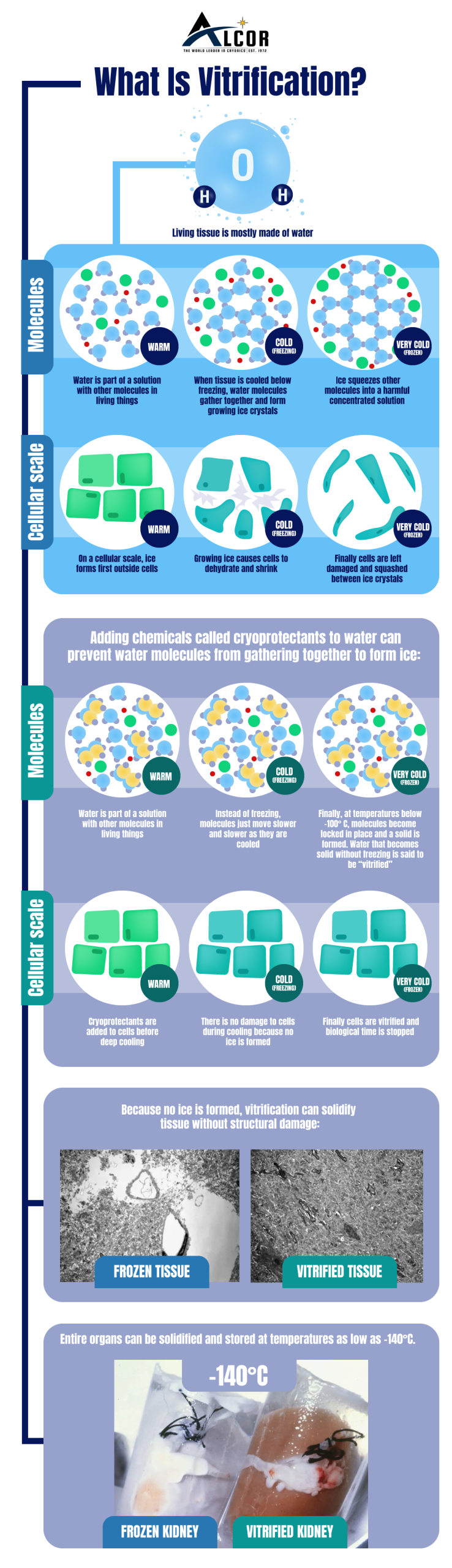
A: When tissue is slowly cooled, ice first forms between cells. The growing
ice crystals increase the concentration of solutes in the remaining liquid around
them, causing osmotic dehydration of cells. If cryoprotectants are present,
the freezing point of the unfrozen solution drops sooner and faster, limiting
the total amount of ice that forms. As the temperature drops below -40°C,
the cryoprotectant concentration becomes so high in the remaining unfrozen solution
that ice stops growing. Cells survive suspended in the residual unfrozen liquid
between ice crystals. As the temperature drops below about -100°C, this
unfrozen solution containing the cells becomes a glassy solid.
| top |
Q: What is vitrification?
A: During ordinary freezing, the cryoprotectant concentration between ice crystals
becomes so high that ice growth eventually stops. What if you start with a cryoprotectant
concentration that is so high to begin with that ice never forms at all? That
is vitrification. The combination of rapid cooling and high cryoprotectant concentration
to completely avoid ice formation was first suggested in the paper, "Vitrification
as an Approach to Cryopreservation" (Cryobiology
21, 407-426 (1984)). Embryos, ova, skin, pancreatic islets, blood cells,
blood vessels, and other tissues have since been successfully vitrified. Whole
kidneys have been reversibly cooled to -50°C (-58°F) with full recovery
when protected by vitrification solutions. Vitrification is now widely regarded
as the most promising approach for long-term banking of large organs.
| top |
Q: Why so cold?
A: Whether tissues are preserved by vitrification or freezing, cells end up
in an unfrozen cryoprotectant solution. This solution becomes more and more
viscous (syrupy) with cooling until a temperature called the glass transition
temperature is reached. At this temperature, the viscosity rises dramatically,
and the solution becomes a glassy solid, locking all molecules into place. The
glass transition temperature is near -120°C for typical organ vitrification
solutions. Above this temperature, chemical reactions can still slowly occur.
Below this temperature, translational molecular motion is stopped, and chemistry
can no longer happen. Biological time is stopped.
| top |
Q: What about fracturing?
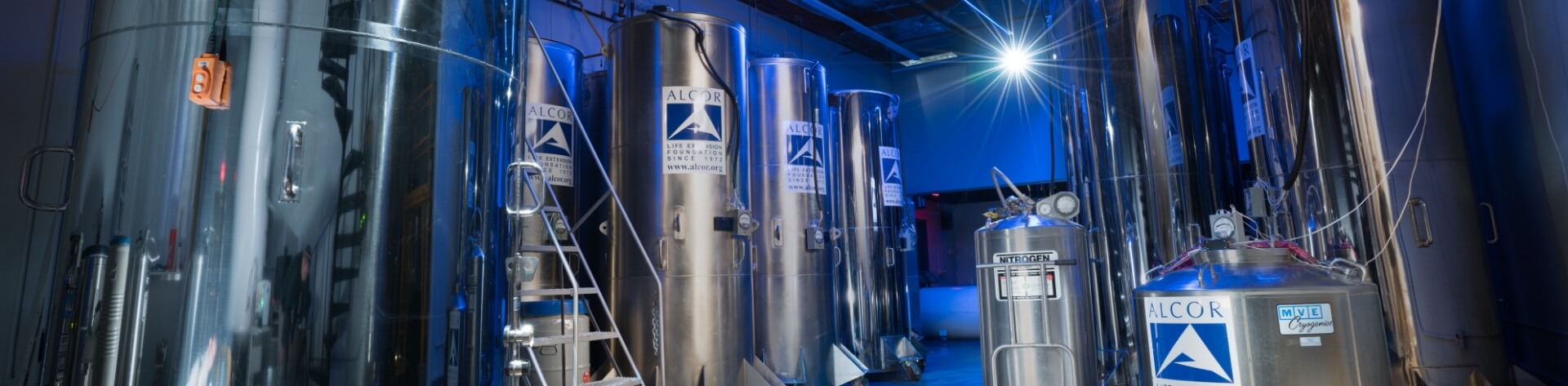
A: Alcor currently uses liquid nitrogen at a temperature of -196°C to store
cryopatients. Liquid nitrogen is stable, reliable, and relatively inexpensive.
The disadvantage of liquid nitrogen is that it is much colder than the glass
transition temperature. Large cryopreserved objects tend to fracture if cooled
far below their glass transition temperature. This occurs whether objects are
preserved by freezing or by vitrification. Acoustic measurements and physical
examination of rewarmed tissue suggest that apporoximately a dozen fractures
may be typical as liquid nitrogen temperature is approached. Scientists at Carnegie
Mellon university and Organ Recovery System, Inc., recently received a $1.3
million dollar grant from the federal government to study this problem.
It is important to understand that fractures are not open cracks. Cryopreserved
organs, even if fractured, remain integrated objects prior to rewarming. An
intact, but cracked, glass winshield is a good analogy. Chemical bonds are broken
across the fracture, but nothing moves more than a few microns (millionths of
a meter).
While fracturing sounds like a serious problem, it probably isn't from the
standpoint of future medicine because little information loss likely results
from it. The biggest problem with fracturing is that the rest of the cryopreservation
process is getting so good that fracturing is moving to the forefront as the
next problem to remove on the way to reversible suspended animation. Therefore
Alcor is now testing a new patient care system that will operate at warmer temperatures
to avoid fracturing. The fracturing problem is discussed further in the article
Cryopreservation
and Fracturing.
| top |
Q: What is neuropreservation?
A: Cryonics currently requires extremely advanced technology for reversal --
technologies capable of molecular-level diagnosis, repair, and regeneration
of tissue (nanomedicine). For such technology, many injuries that we would today
regard as immediately fatal will be reversible. Indeed, it is possible to foresee
a time when virtually any injury that left the brain intact would be reversible
by programmed regrowth
of other tissues following any necessary brain repairs.
This raises an obvious question: Why not transport just the brain to the future?
Many Alcor members have asked themselves this question. A majority have in fact
decided to concentrate all cryopreservation efforts on their brain. For these
members, it makes no sense to preserve ten times more tissue than necessary.
Nor does it make sense to compromise the condition of the brain while trying
to preserve a large mass of aged, diseased tissue that may very well be completely
replaced during revival anyway. Brains are compact, inexpensive to store, easy
to move, and are a single organ for which cryopreservation protocols can be
completely optimized.
Cryopreservation that is focused on doing the best possible job to preserve
the human brain is called "neuropreservation." The brain is a fragile organ
that cannot be removed from the skull without injury, so it is left within the
skull during preservation and storage for good ethical and scientific reasons.
This gives rise to the mistaken impression that Alcor preserves "heads". It
is more accurate to say that Alcor preserves brains in the least injurious way
possible. As a practical matter, cephalic isolation (or "neuroseparation") is
performed by surgical transection at the sixth cervical vertebrae. Non-cryopreserved
tissue is handled in accordance with member wishes. Cremation is common.
For more information see the Neuropreservation
FAQ in the Alcor Library.
| top |
Q: Will bodies be replaced by cloning?
A: No. Cloning (nuclear transfer into ova) is a crude technology that will
be superseded by direct installation of new growth programs into cells at sites
of injury. Such programs will eventually include the ability to regrow severed
spinal cords, lost limbs, and even new organs when necessary. For severe trauma
victims, it is possible to envision enclosed fluid support environments within
which massive injuries could be programmed to heal while the patient remains
asleep. Such healing processes could, if necessary, include regeneration of
a new body around an isolated, repaired brain. Tissue and limb regeneration is currently
an active area of research,
although it is still in very early stages. It may not reach its full potential
for a century or more. A fictitious scenario to help envision how tissue regeneration
might be someday be applied in cryonics can be read at Resuscitation:
A Speculative Scenario.
In summary, we do not believe revival of neuropatients will involve anything
as primitive as cloning or transplants. It seems much more likely that the patient's
own cells will be prodded into regrowing the body that belongs around the brain
in a reprise of the natural process that made the body in the first place. This could be done by combined natural and specialized growth programs, and also augmented by direct synthesis of scaffolding and cell placement by nanomedicine.
| top |
Q: Why isn't vitrification reversible now?
A: To vitrify an organ as large as the brain, Alcor must expose tissue to higher
concentrations of cryoprotectant for longer periods of time than are used in
conventional organ and tissue banking research. The result of this exposure
is biochemical toxicity that prevents spontaneous recovery of cell function.
In essence, Alcor is trading cell viability (by current criteria) in exchange for the excellent structural
preservation achievable with vitrification.
The nature of the injury caused by cryoprotectant exposure is currently unknown.
We are hopeful that it is a relatively minor injury given that our solution
compositions and exposure times are not radically different from the compositions
and exposures known to permit complete functional recovery of kidneys in published
research.
| top |
Q: Has an animal ever been cryopreserved and revived?
A: Small roundworms (nematodes) and possibly some insects can survive temperatures
below -100°C. However, since scientists are still struggling to cryopreserve
many individual organs, it should be obvious that no large animal has ever been
cryopreserved and revived. Such an achievement is still likely decades in the
future.
Frogs, turtles, and some other animals can survive "freezing" at temperatures
a few degrees below 0°C. These animals are frozen in the sense that significant
fractions of their body water converts to ice. However they are not truly cryopreserved.
The fluid between ice crystals is still liquid, chemistry is slowed, not stopped,
and the state can only be sustained for a few months. If these animals were
cooled to temperatures required for true long-term stability (i.e. below the
glass transition temperature) they would not survive.
| top |
Q: Why not chemical fixation instead of
cryopreservation?
A: Chemical fixation with cross-linking agents can stabilize biological structure
for long periods of time in the liquid state, and it is reversible in principle with molecular nanotechnology.
In fact, the cryonics
chapter in Eric Drexler's book Engines of Creation discusses using
a combination of fixation and vitrification for cryonics patients. However, there are concerns with this approach.
Fixation and storage at ambient temperature has sometimes been proposed as a low-maintenance version of cryonics. This approach is biologically inferior to good cryopreservation for several reasons. First, good chemical fixation is hard to do, and requires multiple agents to effectively preserve all major cell components. Some of these agents are expensive and extremely hazardous chemicals. Any imperfections in fixation would result in decaying tissue, whereas defects in cryoprotective perfusion during cryopreservation only result in tissue freezing rather vitrifying; a limited degree of damage that ends with stability. Second, even the best fixation methods only stabilize a subset of biological molecules by attaching to certain points on the molecules. In contrast, cryopreservation by vitrification provides guaranteed stabilization of every molecule present by turning the whole system solid. Finally, because vitrification is based on solutions and procedures developed for preservation and recovery of living tissue, tissue preserved using state-of-the-art vitrification solutions are intrinsically closer to viability, and normal biological condition, than tissue preserved using techniques developed for histological endpoints.
Fixation in combination with vitrification theoretically provides added security if a vitrified patient were ever to be prematurely warmed. However fixation has been found to worsen freezing injury by causing intracellular ice formation, so it would increase harm to tissue in areas that didn't successfully vitrify. Also, fixation commits patients to a very high level of future technology for revival; a level higher than may be required to reverse cryopreservation alone, especially as cryopreservation technology improves. The use of fixation, either alone or in combination with cryopreservation, is therefore incompatible with the development of methods for reversible suspended animation using any near-term technology.
| top |
Q: Where can I learn more about cryobiology?
A: Read the brief introductory
article by Dr. Gregory Fahy or the on-line
textbook by Drs. Ken Muldrew and Locksley McGann. There are other interesting
cryobiology links on our links page.
| top |
Q: How can I prepare for a career in cryonics?
A: Although cryonics has been growing at an average rate of about 10% a year
for the past two decades, it is still a very small field. There are fewer than
20 people employed full-time in various companies and organizations directly
involved in cryonics, although many more people are involved in scientific research
that is relevant to cryonics.
There are basically two tracks that can potentially lead to a career in cryonics:
the medical track, and the science/engineering track. Medical professionals
valuable to cryonics include paramedics, perfusionists, nurses and physicians.
Expertise within these fields is essential to the modern practice of cryonics.
Alcor employs various combinations of these professionals on either a full-time
or contract basis.
Scientists and engineers are necessary to develop and validate cryonics procedures,
and build specialized equipment to implement them. The scientific research areas
most relevant to cryonics are cerebral resuscitation (to develop better methods
of initial treatment of cryonics patients), organ cryopreservation (to develop
better methods of long-term preservation), and neuroscience (to validate preservation
methods). The academic fields of biochemistry, physiology, and neuroscience
are good preparation for research in these areas.
Organ cryopreservation is a small specialty of the field of cryobiology, which
is the study of life at low temperatures generally. Any student contemplating
a career in cryobiology should be aware that cryonics is a highly controversial
subject among cryobiologists. For more information about the field of cryobiology,
see the non-corporate links in The Science of Cryobiology section our links
page.
Any career decision involving cryonics should be made from the perspective
of finding a field that it is interesting and remunerative in its own right,
with cryonics or cryonics research regarded as a possible future application
of your skills.
| top |
| next page |
|