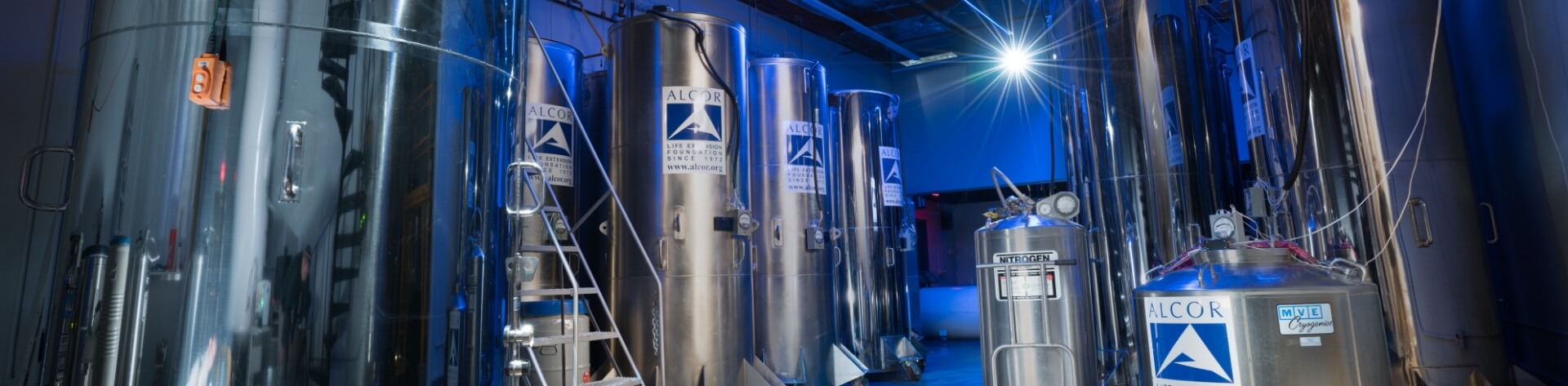
Alcor is pleased to announce the appointment of Lisa Shock to the position of Membership Communications Director. Lisa has participated in cryopreservation cases at Alcor and has helped out in other ways. The staff, management, and the board welcome Lisa to the Alcor staff. We also thank Life Extension Foundation for funding this new position for the first year.
Lawsuits against Larry Johnson End; Johnson Issues Statement
Alcor’s lawsuits against Larry Johnson have been ended by his bankruptcy and various concessions. In 2009 Alcor sued authors Larry Johnson, Scott Baldyga, and publisher Vanguard Press in New York for their book Frozen, which purported to be about Alcor. The lawsuit was filed to obtain damages for the false and defamatory content of the book, to enforce prior court orders and agreements which publication of the book directly violated, and to protect the privacy of Alcor members. Bankruptcy papers filed by Johnson end Alcor’s ability to collect damages related to this lawsuit from Mr. Johnson, unless there is a subsequent violation of terms by Mr. Johnson. All court orders remain in force to prevent future violations.
In connection with the end of litigation, Larry Johnson has issued this public statement:
“When the book Frozen was written, I believed my conclusions to be correct. However information unknown to me and a more complete understanding of the facts furnished by ALCOR contradict part of my account and some of my conclusions. In light of this new information from ALCOR, some parts of the book are questioned as to veracity.
“For example my account of the Ted Williams cryopreservation, which was not based upon my first-hand observation as noted in my book, is contradicted by information furnished by ALCOR. I am not now certain that Ted Williams’ body was treated disrespectfully, or that any procedures were performed without authorization or conducted poorly.
“To the extent my recollections and conclusions were erroneous, and those recollections and errors caused harm I apologize.”
False allegations of mistreatment of member remains were the centerpiece of sensational publicity sought by Mr. Johnson in 2003, and subsequently during his promotion of the book Frozen in October 2009. Yet they were just a few of the many falsehoods contained in the book Frozen and the surrounding publicity. The lawsuit against the book’s coauthor, Scott Baldyga, and publisher, Vanguard Press, continues in New York. Alcor is seeking money damages against Mr. Baldyga and Vanguard Press for aiding and abetting violation of court orders, ignoring valid court injunctions, and otherwise assisting in the distribution of false information about Alcor.
Alcor CEO, Max More, stated, “We are very pleased that Mr. Johnson has publicly retracted his allegations about Alcor. Alcor feels vindicated from the falsehoods perpetrated by Mr. Johnson. Alcor is a professional cryopreservation facility dedicated to the well-being and privacy of its members.”
Next Alcor Board of Directors Meeting
The next Alcor Board of Directors meeting is scheduled for Saturday, March 3, 2012, at 11:00 AM (MST) at the Alcor facility (7895 East Acoma Drive in Scottsdale, AZ). Members and the public are encouraged to attend.
Medical Response Director Report
Case Report for A-1546
A-1546 was born in Raton, New Mexico, a city just south of the Colorado-New Mexico border, on November 26th, 1938. Known as ‘Bucky’, he served with honor in the US Coast Guard, and then attended the Colorado School of Mines to become a land surveyor. He was a husband, father, grand-father and was married to his wife for 41 years.
A-1546 possessed a brilliant and analytical mind, had a keen sense of humor and an unquestionable personal ethic. A member of Mensa, he eagerly embraced technological innovation, and was a vocal proponent of future developments.
A-1546 became a member of Alcor in 1995. His health declined in his early 70′s from metastatic gastric cancer and his clinical death occurred at 5:20 PM on November 9th of 2011, at his home in Kirkland, WA. This case report will be published to Alcor’s website shortly.
Public Education & Media
Alcor has conducted 4 tours this past month with a total of 37 attendees.
This included two separate tours for a local college’s medical ethics course where students could learn and discuss the various aspects of postmortem directives, anatomical donations, interactions with medical providers and cooperation from relatives.
Another tour was provided for Dr. Jaime Lagunez from Cuernavaca, Mexico who is the Scientific Director of the American Association of Cryopreservation. As a human rights activist, he strongly supports cryonics as a personal choice and is working to promote the continued development of the science throughout Spanish speaking nations.
During 2011, there were a total of 61 tours given for 246 attendees. Groups included Arizona State University, Ottawa University, Glendale Community College, Tucson Unified School District, Bryman College, Barry Aaron’s office, TEDMED and the World Futurist Society. International visitors came from Finland, Russia, China, Italy and Mexico.
Medical Event Tracking
During the month of December, 7 Alcor members that had either some type of surgery or significant medical procedure performed that we tracked. Some events were planned and others were urgent. Either way, we are pleased that members are being proactive and alerting us prior to events occurring.
A typical scenario involves receiving a call from an individual about an upcoming procedure. Two forms are often provided to the individual – one that allows them to input all of the specifics of their surgery/procedure including date, time, location, surgeon, contacts, etc, – and the other form they give to their medical providers that articulates the purpose of their directives and requests specific action in the event of a clinical death. Occasionally, calls will be made to the medical providers, at the request of the member, to answer specific questions physicians and/or administrators may have. Alternatively, if a procedure is urgent and there is no time for this process, the information is recorded and disseminated to the deployment committee for evaluation.
Readiness and Technical Coordinator Report
Overseas Neuro Dry Ice Shipping Container
With specific performance goals provided by Max More and Steve Graber have been developing a super-duty dry ice international neuro shipping container. (SDDIINSC) The unit that Steve developed with input from Hugh Hixon and Aaron Drake provides a superior level of insulation and travel protection, and a dry ice performance period (sub -70C) of ~4.5 days. The case shell is a cube shape Peli 340 with detachable roller feet and wide lifting handles on either side. It appears to be virtually indestructible. The case innards consist of a standard U-Line brand styrofoam dry ice shipping box which has been modified to our specification and press-fit into the Peli plucked foam protective liner.
Prior dry ice tests performed on the U-line box alone resulted in a dry ice temperature period of ~2.5 days, the insertion of the Styrofoam into the Peli container has extended this time period to at minimum 4.5 days. Steve has several ideas as to how to extend that time frame an additional day or possibly two. During the test, a 4 liter bottle filled with E.G. gel simulating a cryoprotected cephalon was placed in the box.
The container was plunge cooled to -70C over a period of 1.5 days using 25 Lbs of crushed dry ice. Once dry ice temp was achieved an additional 12 Lbs of crushed dry ice was added to the box and the box was closed. A thermocouple probe was inserted into the center of the bottle and a second probe was attached to the outer surface of the bottle. The test was run until both thermocouples warmed to ~-50C. development team added venting to the Peli case to allow the CO2 to vent and the Peli case was opened several times during the test to simulate inspections that will likely occur at various points along its trip. The ‘reload with dry ice’ spike in the graph below was inserted artificially for display clarity.
Administrative Report
Membership Statistics
Alcor had 957 members on its Emergency Responsibility List. Two memberships were approved during the month of December, one membership was reinstated, three memberships were cancelled and one member was cryopreserved. Overall, there was a net loss of one member in December.
Applicant Statistics
Alcor had 42 applicants for membership. Two new applicants were added, three applicants were converted to members and one applicant was cancelled resulting in net a loss of two applicants in November.
Information Packet Statistics
Alcor received 95 info pack requests in December. Fifteen were handed out during facility tours or from special request. The average total of 104 info packs sent per month in 2011 compares to 199 in 2010. The full Information Packet is now available online.
Paper Copies of the Cryonics Magazine
Courtesy of the Life Extension Foundation, Alcor is pleased to announce that paper publications of the 1st Quarter 2012 Cryonics magazine will be available shortly. Complimentary printed copies of the Cryonics magazine will be shipped to all members and subscribers sometime next week. To view current and past issues of the Cryonics magazine online click here: Cryonics Magazine.
Next Alcor Board of Directors Meeting
The next Alcor Board of Directors meeting is scheduled for Saturday, February 4, 2012, at 11:00 AM (MST) at the Alcor facility (7895 East Acoma Drive in Scottsdale, AZ). Members and the public are encouraged to attend.
Alcor Northern California Meeting & Potluck
The Alcor Northern California meeting will be held this Sunday, January 8, 2012, at 4:00 pm. The meeting will take place at the recreation room of Cypress Point Lakes condominiums: 505 Cypress Point Drive, Mountain View, California.
Attendees are asked to bring a favorite dish to share and swimming attire for the sauna and hot tubs/hot pools.
To RSVP send an email to: mark_galeck@pacbell.net
Patient CT Scan Project
During the month of November the research and development team made a field trip to a local medical CT scanning service, taking with them two recent neuro patients. Due to circumstances surrounding their death, one patient was cryoprotected and the other was not.
Patient safety is Alcor’s main objective, and with that in mind our neuro patients were transported inside individual liquid nitrogen dewars securely tied down and well padded against vibration in the back of our Rescue Vehicle.
Having safely returned from our trip and taking care of returning the patients to the patient care bay, Steve Graber opened up the first of the patient scan files in our 3-D visualization software.
This is where the team could really see some interesting things. First, using the ‘Slice’ tool to remove a small section of the skull (Fig. 1) and looking into the brain cavity we could make out the sensor wires which were previously placed into the brain cavity during surgery. Through the slice we can see variations in brain density which is visible in the red and purple range. NOTE: Color designations are entirely arbitrary.
A direct comparison of two brains digitally enhanced in software (Fig. 2) highlights unusual density variations between brains. When one compares these identically composed, sectioned and displayed images of a cryoprotected brain (top image) vs non-cryoprotected brain it is clear that there is a big difference in overall density between these two brains. A-1546 displays a significantly greater electron density than A-1088 throughout the majority of the brain.
Overall the A-1546 brain is much more electron dense and we believe this to be evidence that perfusion did occur, at least in certain areas. It is important to note that we do not feel that complete perfusion of cryoprotectant was achieved across the entire brain. This may be due to the fact patient A-1546 was pronounced out of state and experienced a travel time of 18 hours from pronouncement to the beginning of the cryoprotective ramp in the Alcor O.R.
A future test of a variety of substances under the CT scanner in LN2 is expected to help to identify electron density specifics of cryoprotectants, which in turn will make our analysis that much more complete. We also expect to test a locally pronounced patient vs an out of state pronounced patient to determine the quality differences in cryoprotection caused by the time-lag to cryoprotection between these two scenarios.