• Home
  • Alcor
  • Cryonics Magazine
  • Facebook
  • RSS

Posts in category Research & Development

Research and Development

Sep02
2009
Written by admin

Emergency Response Vehicle
Regarding the planned renovations to Alcor’s emergency response vehicle, we have completed an intensive design and development phase. This consisted of several meetings between Steve Graber and the technical staff, with discussion of parts, vendors and viewing of product samples. Great care has been taken to select modular, off-the-shelf parts, although some custom-designed pieces will be required. Demolition began on the vehicle’s interior this past week and the approved design pieces are being acquired.

Remote Perfusion
Alcor is currently striving to further develop its remote perfusion capability. Before launching an initiative to train its emergency response staff, however, the appropriate equipment needs to be selected.

READ MORE »

Research and Development

Mar19
2009
Written by admin

Semi-Annual IACUC Meeting
Our semi-annual IACUC meeting was held in December, with its regular review of the animal protocols and facility inspection. The committee requested a few modifications to safety protocols and the development of standardizing forms for some activities. Everything else was in order.

Whole-body Vitrification System
We have begun the large task of documenting the whole-body vitrification software, and work continues to refine the enclosure.

Research and Development

Dec29
2008
Written by admin

Whole-Body Vitrification System (Technical Version)
During the on-going development of the perfusion process control system, we found it necessary to remove one of the controllers from the system. We found the particular controller to be providing unreliable signals at low RPM speeds, in particular the signal we were using to determine main pump flow rates. The inconsistency was due to frictional effects as the pump rollers hit the pump shoe and the rotation rate slowed. Because we use a linear look-up table to estimate the flow rates, addressing this inconsistency would require a non- linear look-up table to fix.

Because non-linear look-up tables are hard to maintain and because we had another alternative available, we decided to remove that particular controller. This, in turn, necessitated modifying the code to accommodate this change and some re- wiring of the system. Fortunately, this means that we have a reduced amount of third-party hardware and wiring, and the control functions are actually easier.

The main issue with this removal is that we needed a new way to calculate flow rates, but a solution was readily at hand. We were able to take the main pump control module, which still had seven open channels for future scalability, and use its analog output signal to make the flow calculations (once again using a linear lookup table). Changes were tested with the perfusate process controller driving the main pump, using the controller to cause pressure changes following a sinusoidal curve.

Aschwin de Wolf becomes a Voting R&D Committee Member

Dec16
2008
Written by admin

Through unanimous vote of the Alcor board, Aschwin de Wolf was added as a voting member of the Research and Development Committee. Other voting members include Steve Harris, MD, Tanya Jones, Regina Pancake and Brian Wowk, PhD.

Technical Updates

Nov26
2008
Written by admin

Research and Development
Refinements continue on the whole-body enclosure for the vitrification system. We have been working to adjust the liquid nitrogen flows and temperature distribution across both the cooling stage and the patient environment. The testing this month included:

1. Performing a trial run of the cDAQ – 9172 unit from National Instruments.
2. Performing an extreme cold test of the redesigned and prototyped enclosure lid.
3. Gaining and recording data on the cooling efficiency of the table for use in fine tuning of liquid nitrogen delivery.

Research and Development Committee
Through a unanimous vote from the Board, R. Pancake was added to the Research and Development Committee. Other voting members include Brian Wowk, PhD, Steve Harris, MD, and Tanya Jones. The Research and Development Committee determines uses for the Readiness Grant provided by the Life Extension Foundation, the Miller family, and Edward and Vivian Thorp.
Readiness Grant

LINK TO: READINESS GRANT

Alcor’s first use of the readiness grant was to help fund some much needed improvements to its stabilization and transport kits, which were featured in the August 2008 issue of AlcorNews. The funds were used to purchase the following:

9 new sets of medications, with assorted supplies for medication administration;
1 Michigan Instruments Thumper repair;
6 rescue baskets for the construction of new ice baths, with assorted materials;
1 box of arterial cannula for ATP;
Labor for construction of 6 new ice baths;
Labor for construction of 9 medication kits.

We thank the Life Extension Foundation, the Miller family and Edward and Vivian Thorp for their donation towards readiness improvements of $32,639.68.

Presently, all the below first response teams in the field have fresh medication kits with up-to-date medications:
Alcor Central
Massachusetts
Northern California
Southern California
Florida
Nevada
United Kingdom

Continued work is being done to improve the stabilization and transport kits.

Technical Updates

Oct01
2008
Written by admin

Cart Caddy
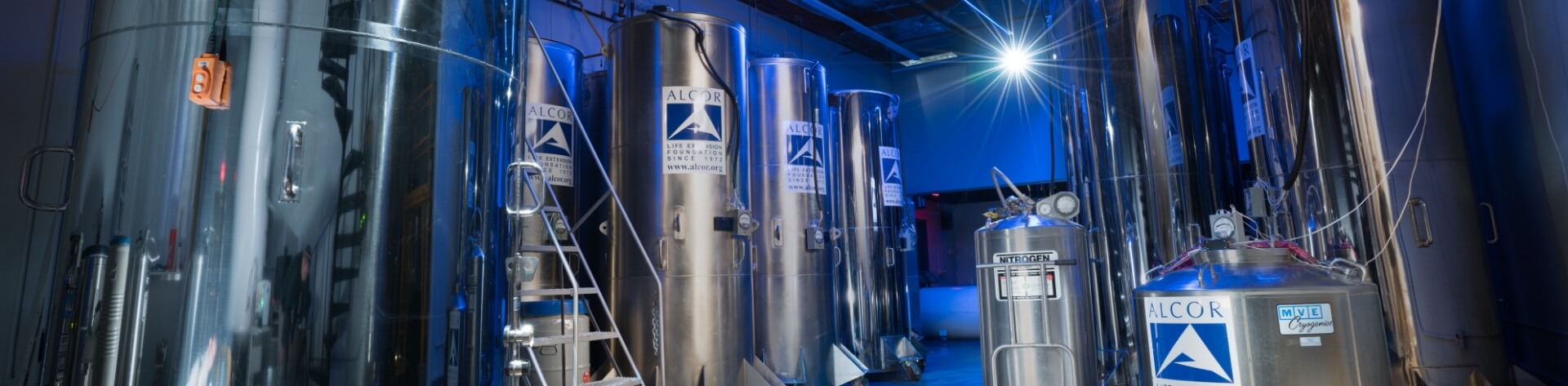
We have recently purchased a necessary piece of equipment called a Cart Caddy for our patient care bay. Whenever there is a need to fill new dewar(s) with liquid nitrogen or to transfer patients from a cool down unit into a permanent dewar, the dewar must be moved into position. This used to take a minimum of four strong people to manually push the dewar. With the Cart Caddy, it is now a two-person job (one to operate the machine, the other to supervise). It is also a much safer and easier approach to the moving a dewar that weighs 5500 lbs. We have adapted this unit so that the crescent shape hugs the dewar firmly and allows us to maneuver it with little effort.

As our patient population grows, this small piece of equipment will become an important asset to our patient care bay.

Research and Development
The development of the whole-body system progresses with some changes to the user interface which will make the system easier to use and yet also provide more clarity on the data being generated at any given moment. We have also expanded significantly the note-taking capability of the system. We are at the point of final engineering testing for the ramp generation portion of the system and have yet to verify our 3-point calibration.

ATP and Whole-Body Vitrification System — Alpha Tests

Sep08
2008
Written by admin

We held our alpha test of the new ATP and the whole-body vitrification system this month using a swine as test subject.

Given that this was our first large animal operation in many years, we had something of a learning curve with regard to animal handling and the specific surgical procedures necessary for performing bypass. We chose to cannulate the carotid artery and internal jugular vein for the procedure. I performed the cannulation and Regina Pancake assisted, and the surgery went quite smoothly. We had the animal on bypass in 45 minutes, which our observing veterinarian considered quite successful. We began our equipment testing with the new transport perfusion system.

We needed a mere five minutes to prepare and prime the system prior to cannulation, but this figure was artificially high because the two people preparing the system had to refresh their memories about how to hang the perfusate bag. A time of less than two minutes to prepare the system is the benchmark for our next test. All of the new elements worked well, and we had no problems at all with the new ATP. We did not test it fully on a closed circuit, only for open flush of the swine, in order to start testing the whole body system.

Our whole body system consists of two parts that we tested: the patient enclosure and the computer-controlled perfusion. The patient enclosure involves an operating stage that cools the patient using liquid nitrogen injected into a plenum underneath the patient, fans to circulate nitrogen around the patient, a transparent – but internally lighted – cover for the patient, and enough seals to keep the nitrogen – both vapor and liquid – precisely where they should be.

The cooling stage cooled quite rapidly to the set temperature. We added controllers for that only recently, because we were still modifying the enclosure based on previous test results. The temperature controllers need to be adjusted slightly by modifying how the cooling curve is handled, but it took less than ten minutes to cool the stage to three degrees C. We were quite pleased with the even nature of the temperature, and Randal Fry is to be commended for his efforts to adjust the nitrogen spray to accomplish this result. The table itself is also at a more comfortable height for performing surgeries.

The perfusion system itself was the biggest unknown. Of course, the programmer knew precisely how the system would respond to our tests; because it was doing everything he told it to do. The calibrations of the system went well, as did the system initialization. Our cryoprotectant ramp control handled itself very well. Pressure control did not go well, and this was because we had been using the pressure control in a way that worked with an unloaded system (there was no body in the loop). This made a big difference, and we will be adjusting that portion of the program accordingly.

Our alarm functionality worked quite well. A clamp on a line that causes the pressure to spike resulted in immediate shut off the main pump. Level indicators worked well, and all the pumps in the system responded appropriately. Both manual and automatic control of all parameters functioned as intended. We have some minor tweaks to make to the user interface, but those are primarily cosmetic.

Elements that were not quite ready for the test included the full reporting functionality, though the pure data collection elements are all working well; the bubble alarms are not installed; and neither is the emergency stop button we intend to place on the patient enclosure (in case the surgeon sees something requiring immediate cessation of perfusion). We will be performing additional tests on the system’s memory requirements, to ensure that we will not have any problems during a long case. Once we tested the perfusion system to that extent, we tested the final element of the patient enclosure: the ability of the system to perform first-stage cooling.

This is the step where we plunge the patient’s temperature to just above the glass transition point for M22, -110 degrees C. The table itself cooled to -110 in eleven minutes, though of course, it took longer for the swine to reach that stage. Using an animal that was not vitrified caused the temperature to be reduced more slowly because of the heat requirements for the ice formation, but the swine passed the freezing point in 3.5 hours. We considered this acceptable under the test conditions. The swine’s temperature continued to drop until it reached -95 degrees C, at which point we discontinued the test. That drop took approximately 18 hours. This time is good, given that not all elements of the system worked exactly as intended, and we expect faster times as adjustments are made. We did find it took a considerable amount of nitrogen to reach that stage, but part of this is because our environmental fans failed. We will be looking into different fans for the next test and other improvements to reduce nitrogen consumption.

Overall, everyone was quite pleased with the results, and we expect to make the necessary modifications quickly and are planning our second test for later this week.

This work was done under the supervision of the Alcor Institutional Animal Care and Use Committee under Alcor’s USDA registration as an animal research facility, and was fully compliant with the requirements and standards of the Animal Welfare Act. The animals used in these tests were procured from a USDA-registered laboratory animal breeder.

I would like to thank the team who participated in this equipment test, including: Dr. Craig Woods, Joel Anderson, Stephen Van Sickle, Hugh Hixon, Randal Fry and Regina Pancake. We would also like to thank all of the donors who made pursuing this project possible.

Research and Development

Sep04
2008
Written by admin

The Whole-body System The development of the whole-body system progresses with some changes to the user interface which will make the system easier to use and yet also provide more clarity on the data being generated at any given moment. We have also expanded significantly the note-taking capability of the system. We are at the point of final engineering testing for the ramp generation portion of the system and have yet to verify our 3-point calibration.

Redesigned Stabilization and Transport Kits As of August 20, 2008, our Transport Teams in Southern California, Northern California, Massachusetts, Nevada, Florida and the United Kingdom have now been outfitted with the new Med Kits. These kits are the first stage of the Stabilization and Transport Kits currently in development here at Alcor.

The latest configuration for the Med Kit allows for ease of use for our teams when stabilization and transport time is limited and crucial. Each medication is vacuum sealed into a clear plastic package containing all the required elements and written instructions.

Our Southern California Transport Team performed a test run recently at their July training session using a mock up kit identical to the now real and deployed Med Kits. Feedback from the field on the redesigned kit was very positive and greatly appreciated.

Technical Review of M22 on Depressed Metabolism Blog

Jul21
2008
Written by admin

On the blog Depressed Metabolism, Alcor member Aschwin de Wolf
has written a detailed technical review of Alcor’s vitrification agent
M22. The author provides a history of the cryoprotectants that
preceded M22 and notes that the vitrification agent that Alcor
currently is using is also the state of the art in conventional
cryobiological research:

http://www.depressedmetabolism.com/2008/07/08/vitrification-agents-in-cryonics-m22/

On the same blog, Alcor member Shannon Vyff writes about children and
futurism, calorie restriction and cryonics:

http://www.depressedmetabolism.com/2008/07/01/shannon-vyff-on-teaching-children-about-the-future-caloric-restriction-and-cryonics/

Technical Updates

Jul09
2008
Written by admin

Research and Development
Our preparation of the new whole-body vitrification system is nearing the alpha testing phase. The patient enclosure has been tested periodically to ensure our design refinements are performing as expected. Changes include altering the configuration and flow of the nitrogen injectors, adding additional insulation, increasing the size of the plenum, and constructing a mounting platform for the circulating fans.

Readiness
Regina Pancake, Readiness Coordinator, attended the training session held by Cryonics Institute and one of our own in southern California. The focus of the southern California training was a review of changes we have been making to the medications kit. We have settled on a new design that pre-packages everything needed to prepare the medications for administration, and this design was well-received by the southern California team. It is simpler and clearer for the team members, and the few modifications suggested by the team are being implemented.

As part of the recovery process, we have been building new medication kits for the regions. We will soon be replacing all of the med kits in the regions with fresh medications and with the new packaging.

« Older Entries

Recent Posts

  • 40 Scholarships Available to Teens & Twenties 5 2014
  • Resuscitation and Reintegration of Cryonics Patients Symposium in Portland Oregon
  • Bring in a new member and we will credit your membership dues
  • Alcor director Michael Seidl steps down
  • Alcor’s 117th Patient

RSS Cryonics Magazine

  • Cryonics March 2013
  • The Past, Present, and Future of Alcor Membership Dues
  • Reversible Cryonics
  • Cryonics February 2013
  • Does Aging Stop?
  • Consciousness, Natural Selection, and Knowledge
  • Cryonics January 2013
  • Alcor-40 Conference Review
  • Chemical Brain Preservation and Human Suspended Animation
  • Cryonics November-December 2012

Categories

  • Announcements
  • Cryobiology
  • Cryopreservations
  • Legal
  • Media
  • Membership
  • Nanotechnology
  • News & Events
  • Operations
  • Patient Care
  • Readiness & Deployment
  • Research & Development
  • Training

Archives

  • May 2013
  • April 2013
  • March 2013
  • January 2013
  • November 2012
  • October 2012
  • September 2012
  • August 2012
  • July 2012
  • June 2012
  • May 2012
  • April 2012
  • March 2012
  • February 2012
  • January 2012
  • December 2011
  • November 2011
  • October 2011
  • September 2011
  • August 2011
  • July 2011
  • June 2011
  • May 2011
  • April 2011
  • March 2011
  • February 2011
  • January 2011
  • December 2010
  • November 2010
  • October 2010
  • September 2010
  • August 2010
  • July 2010
  • June 2010
  • May 2010
  • April 2010
  • March 2010
  • February 2010
  • January 2010
  • December 2009
  • November 2009
  • October 2009
  • September 2009
  • August 2009
  • July 2009
  • June 2009
  • May 2009
  • April 2009
  • March 2009
  • February 2009
  • January 2009
  • December 2008
  • November 2008
  • October 2008
  • September 2008
  • August 2008
  • July 2008
  • June 2008
  • May 2008
  • April 2008
  • March 2008
  • February 2008
  • January 2008
  • December 2007
  • November 2007
  • October 2007
  • September 2007
  • August 2007
  • July 2007
  • June 2007
  • May 2007
  • April 2007
  • March 2007
  • February 2007
  • January 2007
  • December 2006
  • November 2006
  • October 2006
  • September 2006
  • August 2006
  • July 2006
  • June 2006
  • May 2006
  • April 2006
  • March 2006

Meta

  • Log in
  • Entries RSS
  • Comments RSS
  • WordPress.org

EvoLve theme by Blogatize  •  Powered by WordPress Alcor News
News Blog of the Alcor Life Extension Foundation